
Vapes were marketed as the cleaner alternative to cigarettes: no smoke, no ash, no stale smell. The evidence behind it is less reassuring than the branding suggests. Health organisations and researchers have found that e-cigarette liquids and aerosols can contain heavy metals, aldehydes, volatile organic compounds and ultrafine particles.
The most worrying findings concern disposable devices. Research publicised by the American Chemical Society and the University of California, Davis found that after a few hundred puffs, some disposable e-cigarettes released higher amounts of metals and metalloids than earlier refillable vapes and, in some cases, traditional cigarettes. In one example, a device released more lead during a day’s use than nearly 20 packs of traditional cigarettes.
The main contaminants identified included lead, nickel and antimony. According to the UC Davis summary of the study, some devices emitted high concentrations of these elements as puff counts rose. The researchers then traced part of the problem to the devices themselves: some metals were already present in the liquid, while others leached from internal components into the e-liquid and then into the aerosol inhaled by users.
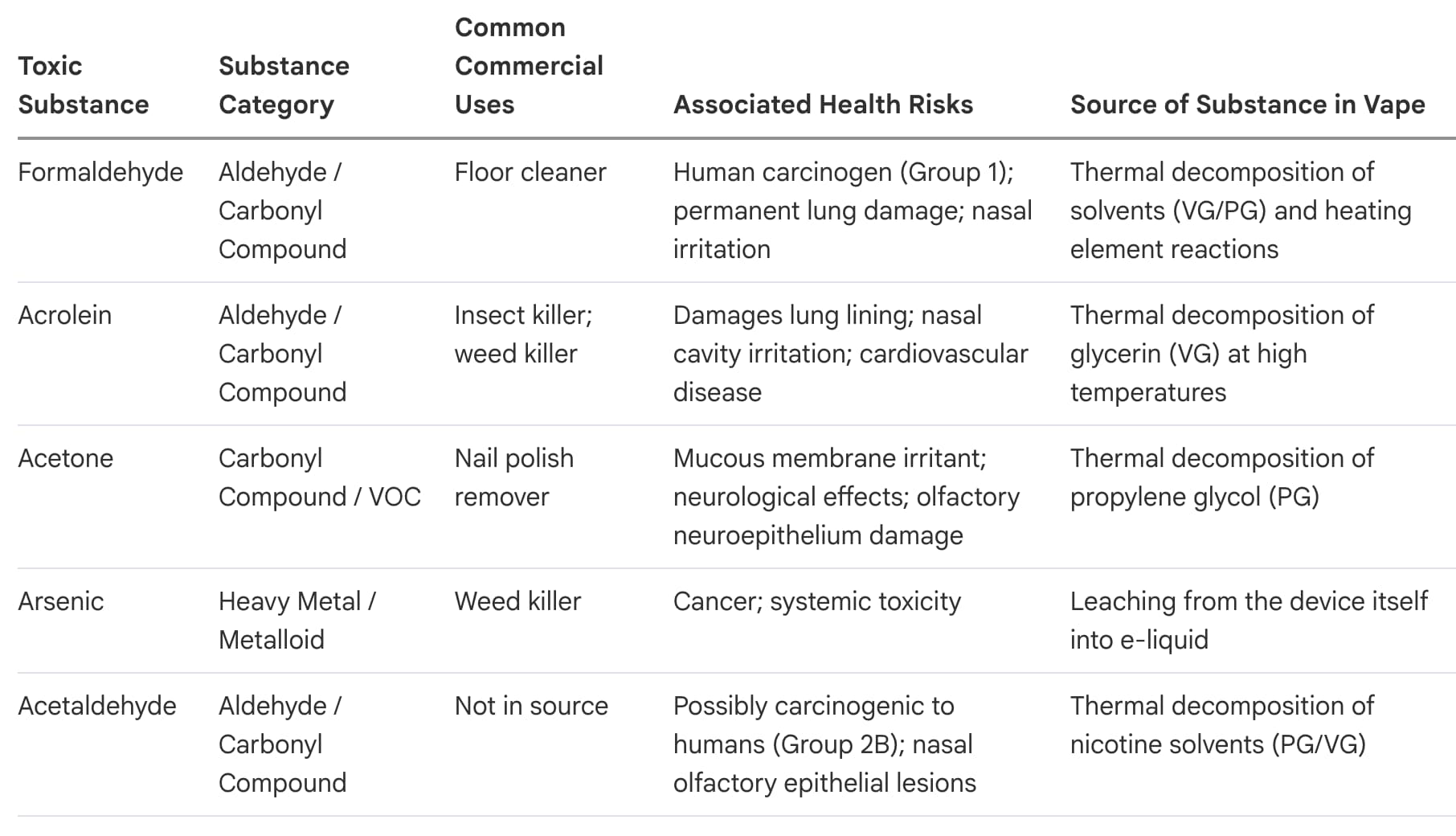
That matters because these are not trivial contaminants. The ACS press summary describes lead as neurotoxic and nickel and antimony as carcinogenic hazards in this context. The UC Davis release adds that, for daily users, some vapour samples exceeded cancer-risk limits for nickel and antimony, while nickel and lead in some devices surpassed non-cancer health-risk thresholds linked to outcomes such as neurological damage and respiratory disease.
scientists still do not fully know what users are inhaling
There is also a broader problem: scientists still do not fully know what users are inhaling. Johns Hopkins researchers reported that vaping aerosols contain thousands of chemicals, many of them unidentified and undisclosed by manufacturers. Their team found nearly 2,000 chemicals, the vast majority unidentified, and also detected condensed hydrocarbon-like compounds usually associated with combustion.
Even common ingredients become more concerning when heated. The American Lung Association says that propylene glycol and vegetable glycerin, widely used as carriers in e-liquids, can break down into formaldehyde and acetaldehyde, both carcinogens. It also notes that e-cigarette aerosols may contain VOCs such as benzene, toluene and xylene, alongside heavy metals and ultrafine particles.
NSW Health Pathology makes a similar point from a public-health perspective. It reports that most of the devices it tested contained nicotine, even though many labels made no reference to it, and lists flavouring chemicals, VOCs, aldehydes and heavy metals among the substances found in vapes. Its conclusion is blunt: introducing such chemicals directly into the lungs is not safe.
References
- American Chemical Society, "Metals found in disposable e-cigarette vapor could pose health risks"
- University of California, Davis, "Disposable E-Cigarettes More Toxic Than Traditional Cigarettes"
- American Lung Association, "Vapor Hiding Dangerous Ingredients: E-Cigarette Concoctions Are Far from Safe"
- Johns Hopkins University, "Johns Hopkins researchers find thousands of unknown chemicals in electronic cigarettes"
- NSW Health Pathology, "What’s Inside That Vape?"